

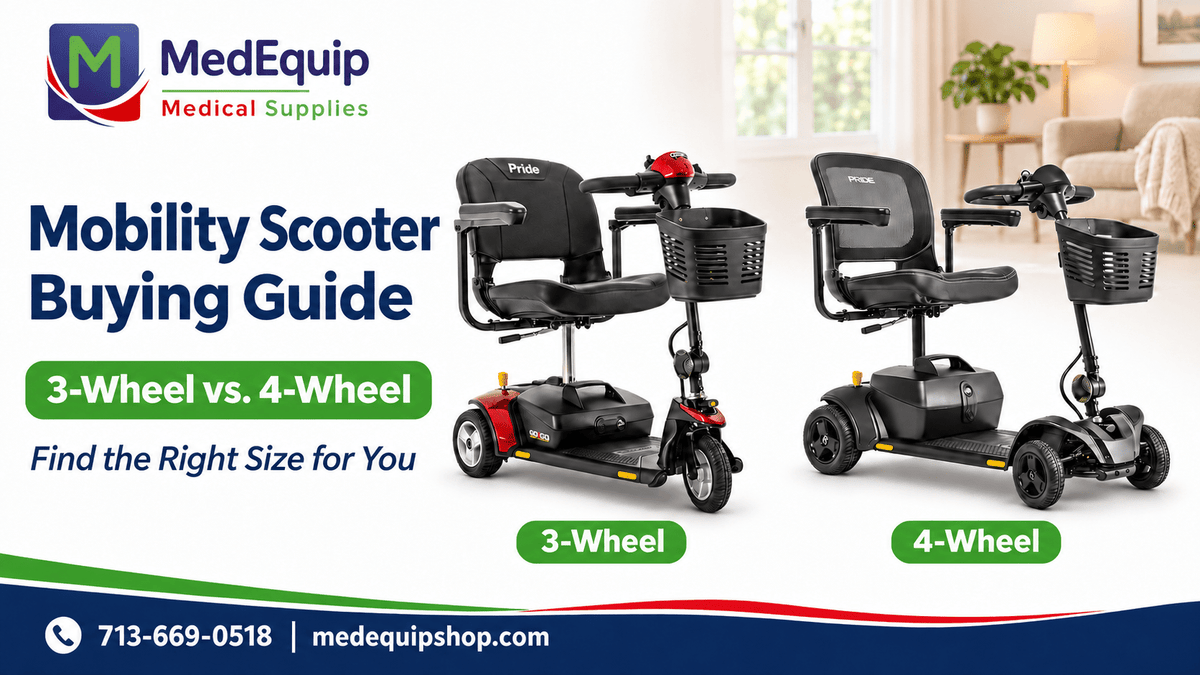
A trip to the grocery store, an afternoon with family, or getting around your neighborhood should feel manageable. The right mobility scooter can make those plans easier. But when two scooters look similar, how do you know which one will fit you and the places you want to go?
Start with your body, your route and how you will transport the scooter. A 3-wheel model often turns more tightly and gives you more open legroom. A 4-wheel model generally provides a wider front support footprint. Neither choice is automatically right for everyone, and the exact model matters more than a simple wheel-count rule.
This guide will help you compare the differences, take useful measurements and ask the right questions before buying.
Should you choose a 3-wheel or 4-wheel scooter?
Think about the places you use most. Are you turning through a small kitchen, visiting stores, traveling by car, or spending longer periods on paved outdoor paths? Start there, then compare individual models.
| What matters to you? | 3-wheel | 4-wheel |
|---|---|---|
| Turning in tighter spaces | Often a smaller turning radius | Varies widely; newer designs can turn tightly |
| Legroom | Often more open around the front wheel | Check the exact deck and knee space |
| Front support footprint | One front wheel | Two front wheels provide a wider front footprint |
| Outdoor use | Depends on the model and route | Depends on the model and route |
| Car transport | Check disassembly and lift weight | Check disassembly and lift weight |
These are shopping guidelines, not a guarantee of performance. A scooter’s tires, ground clearance, suspension, dimensions and manufacturer limits also affect where it can be used. Pride explains the broad differences in its 3-wheel and 4-wheel comparison.
When might a 3-wheel scooter make sense?
A 3-wheel scooter is worth comparing if you regularly make tight turns around furniture or need more room to position your legs. Try the actual scooter with the shoes you normally wear. Check whether your knees clear the tiller and whether your feet rest comfortably on the deck.
Do not assume three wheels means indoor-only use. Ask whether the exact model is suitable for your outdoor route, and compare its manual with the surfaces, thresholds and slopes you expect to encounter.
When might a 4-wheel scooter make sense?
If you prefer the feel of two wheels at the front, start by comparing 4-wheel models. Many customers like that wider front footprint, but the scooter still needs to fit their body and route.
Four wheels do not make a scooter suitable for every surface or slope. Slow down before turning and follow the model’s operating limits. A compact travel scooter and a larger outdoor scooter can both have four wheels while handling very different everyday jobs.
There are also important exceptions to the idea that every 4-wheel scooter needs a large turning area. The Go Go Elite Traveller 2 below is one example of why it is worth checking the actual numbers.
How do you pick the right scooter size?
1. Check your seat, feet and comfortable reach
Scooter size starts with the person sitting in it. Check the usable seat width and depth, space between the armrests, back support and foot position. You should be able to reach and operate the tiller without an awkward stretch.
Ask which adjustments are available for seat height, armrests and tiller angle. Then try getting on and off using the manufacturer’s instructions. If you need specific posture support or have difficulty with transfers or hand controls, bring your clinician or therapist’s recommendations into the discussion.
2. Measure the route through your home
Measure clear doorway openings with the door in its normal open position. Then check the narrowest hallway, the turn into the bathroom and space beside your bed or favorite chair. A scooter that passes straight through a doorway may still need more room to turn afterward.
Compare overall width and length, including anything that adds to the footprint. Check turning radius separately. It describes a turning circle, not a promise that the scooter can turn through every hallway of that width. Photos and a simple sketch can help explain your space when you visit.
3. Compare capacity separately from seating fit
Weight capacity is a manufacturer limit. Confirm how the user’s weight, carried belongings and accessories are counted, and stay within the stated rating. A higher capacity does not automatically mean a wider seat or a better fit.
For a larger rider, compare the actual seat dimensions, legroom and armrest spacing alongside capacity. A heavy-duty scooter may offer useful options, but check each model rather than relying on the category name.
4. Measure your vehicle and check the heaviest piece
If the scooter will travel in a car, measure the cargo opening as well as the space inside. Include the height available under the hatch and the room left for other passengers or equipment.
Ask someone to demonstrate folding or disassembly. Compare the heaviest piece you or your helper will actually lift, not just an advertised frame weight. Folding describes how a scooter packs; it does not guarantee an easy lift. If lifting is not practical, discuss another transport arrangement.
Our travel and portable scooters and folding scooters are useful places to compare those details. Some models belong in both groups.

Two compact scooters that show why model details matter
These two Pride models illustrate how wheel layout, size and transport weight work together. They are separate models, not identical scooters with an extra wheel added.
| Specification | Go Go Elite Traveller 3-Wheel | Go Go Elite Traveller 2 4-Wheel |
|---|---|---|
| Model number | SC40E | SC442E |
| Turning radius | 33 in. | 37 in. |
| Base width | 19.5 in. | 19.45 in. |
| Overall length | 37 in. | 39.37 to 40.79 in. |
| Standard seat | 17 × 17 in. | 17 × 17 in. |
| Maximum weight capacity | 300 lbs. | 300 lbs. |
| Heaviest piece | 29.5 lbs. | 35 lbs., front section |
The Elite Traveller 2 offers a 4-wheel layout with a listed 37-inch turning radius. That is a reason to compare the actual specifications rather than assume all 4-wheel scooters turn alike. It still needs to fit your seat, legs, doorway route and lifting plan.
See the Go Go Elite Traveller 3-wheel listing and Go Go Elite Traveller 2 4-wheel listing. For the source specifications, review Pride’s SC40E specifications and SC442E specifications. Confirm the supplied configuration and current availability with us.
What else should you check before buying?
- Battery range: Plan for your usual day with a reserve. Rider weight, terrain, battery condition and other conditions can affect range. Check the exact battery option supplied.
- Charging and storage: Where will you charge it, and can you comfortably handle any removable battery pack?
- Your outdoor route: Check thresholds, surfaces and inclines against the model’s manual. Four wheels alone do not make a scooter an all-terrain model.
- The complete cost: Ask what is included, which accessories cost extra, and what delivery or setup options apply.
- Service and returns: Review warranty coverage, service arrangements and the return policy before ordering.
Review the Pride Scooter Consumer Safety Guide and the exact model’s manual for operating and transport instructions.
Need help choosing a mobility scooter in Houston?
You do not need to know every model name before calling. Tell us where you plan to ride, what measurements you have and how the scooter will travel with you. We can help you compare available options.
Browse mobility scooters, call 713-669-0518, or visit MedEquip Medical Supplies, 8404 Katy Freeway Suite 200, Houston, TX 77024. Please call ahead to confirm specific models available to view.
For a temporary need, ask about mobility scooter rentals. For more planning help, read our Mobility & Independence guide or power wheelchair buying guide if you are comparing equipment types.
MedEquip Medical Supplies is a cash-pay provider and does not bill Medicare, Medicaid or private insurance directly.
Frequently asked questions
Is a 3-wheel or 4-wheel mobility scooter better?
It depends on your route and the exact model. A 3-wheel scooter often offers tighter turning and more open legroom. A 4-wheel scooter generally offers a wider front support footprint. Compare turning radius, seat fit, terrain limits and transport requirements rather than choosing by wheel count alone.
Can I use a 4-wheel scooter inside my home?
Yes, if the exact scooter fits your clear doorway openings and turning spaces. Some newer 4-wheel designs turn much tighter than older models. Measure your route and try the model before deciding.
How do I choose the right scooter seat size?
Compare usable seat width and depth, space between the armrests, foot support, knee clearance and comfortable reach to the tiller. Weight capacity alone does not establish seating fit. Bring any clinician seating recommendations to your fitting.
Will a mobility scooter fit through a standard doorway?
Do not rely on the nominal door size. Measure the actual clear opening with the door open, then compare the scooter’s widest point, including accessories. Check the turn before and after the doorway too.
Does a folding scooter have to be light enough for me to lift?
No. Folding describes how it packs, not what it weighs. Confirm the weight you will actually lift, whether batteries or the seat are removed, and whether your vehicle opening accommodates it.
What is the weight capacity of the Go Go Elite Traveller 2 4-wheel?
Pride lists a 300 lb maximum weight capacity for model SC442E. Confirm how the user, belongings and accessories are counted, and check the supplied configuration before purchase.
What is the difference between the Go Go Elite Traveller 3-wheel and Elite Traveller 2 4-wheel?
Pride lists a 33-inch turning radius for the SC40E 3-wheel and a 37-inch turning radius for the SC442E Elite Traveller 2 4-wheel. Both list a 300 lb capacity and 17 by 17-inch seating. They are different models with different dimensions and transport weights.
Can MedEquip Medical Supplies help me compare scooter sizes?
Yes. Call 713-669-0518 with your measurements, transport plans and budget. Our Houston team can help compare available models. Call ahead to confirm which models are available to view at 8404 Katy Freeway Suite 200, Houston, TX 77024.
Manufacturer specifications checked November 4, 2026. Specifications, configurations and availability can change.