

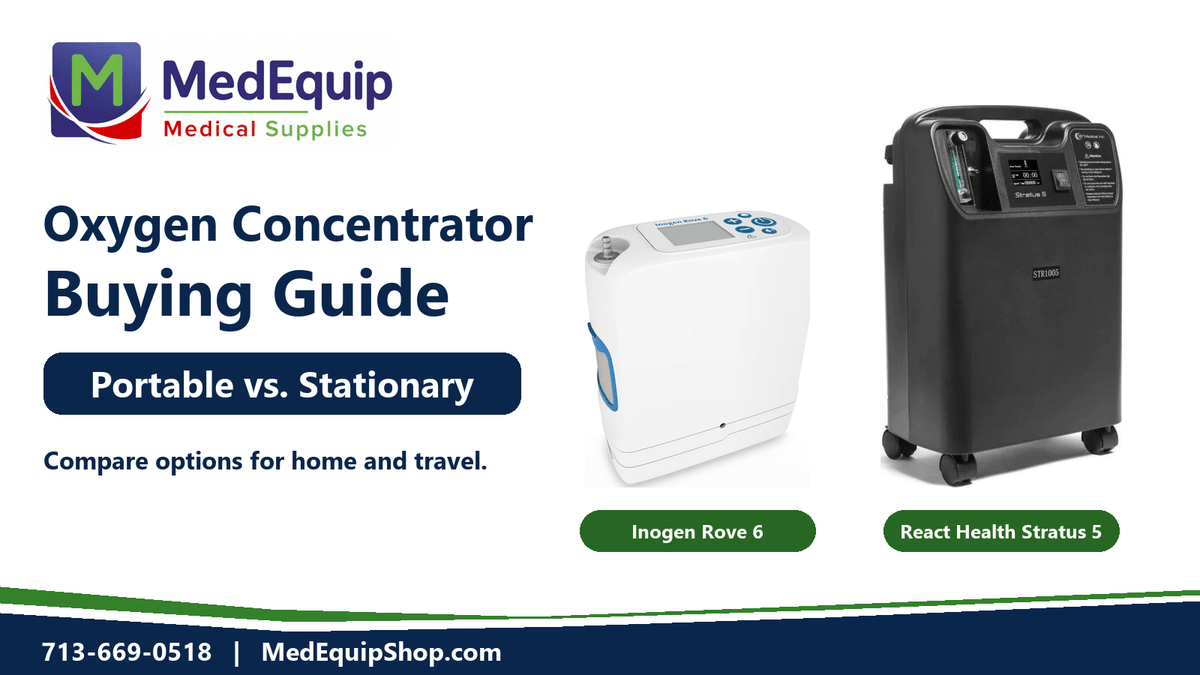
If you or someone you care for has just been prescribed oxygen, it’s natural to wonder whether one machine can work at home, on errands, and on trips. Start with the oxygen prescription. It tells you what the machine needs to deliver before you compare size, weight, or battery life.
A stationary oxygen concentrator is generally the better fit when you need continuous-flow oxygen at home. A portable oxygen concentrator can make it easier to get out of the house if the exact model can deliver your prescribed oxygen during those activities. Some people use a stationary unit at home and a portable unit when they go out. Your oxygen care team can help you decide whether one device or two makes sense.
Watch: Portable vs. Stationary Oxygen Concentrators
How do portable and stationary oxygen concentrators compare?
Both types concentrate oxygen from the air around you. Compare how each machine delivers oxygen, how it gets power, and where you’ll use it.
| What to compare | Stationary | Portable |
|---|---|---|
| Typical use | At home | Errands, appointments, and travel |
| Delivery | Typically continuous flow | Many use pulse dose. Some also offer continuous flow. |
| Power | Wall outlet | Rechargeable battery or compatible external power |
| Moving it | Typically larger and heavier. Some have wheels. | Designed to carry or pull on a cart. Check the weight with the battery installed. |
| What to confirm | Prescribed flow and a backup plan for power outages | Prescribed mode and runtime at your setting |
What’s the difference between pulse dose and continuous flow?
Continuous flow delivers oxygen at a steady rate, measured in liters per minute (L/min). If your prescription calls for 2 L/min continuous flow, look for a machine that can deliver that rate in continuous-flow mode.
Pulse dose delivers a short burst when the device senses you breathing in. A pulse setting of 2 does not mean 2 L/min continuous flow. The amount delivered varies by model. Ask your oxygen care team to confirm the machine and setting for your planned activities. American Thoracic Society oxygen therapy guide

When does a stationary oxygen concentrator make sense?
A stationary unit is often the first option to compare if you spend most of your time at home or need continuous flow. Confirm the machine can deliver your prescribed flow, where you’ll place it, and what backup oxygen plan your care team recommends for power outages.
If you use oxygen while sleeping or with CPAP or BiPAP, ask your care team to confirm the delivery mode and equipment setup you need overnight.
When does a portable oxygen concentrator make sense?
A portable unit can make appointments and everyday outings easier. Once your care team confirms the exact model meets your prescription, compare how you’ll use it on a typical day.
- Battery life at your setting. Check the manufacturer’s estimate for your delivery mode, setting, and battery.
- Weight with the battery installed. Include any bag or cart.
- Time away from an outlet. Plan for the full outing, including delays.
- Charging options. Check which wall and vehicle power accessories work with the model.
Before flying, confirm the model, notice requirements, and battery rules with your airline. Carry enough spare batteries for the flight and protect them from damage and short circuits. FAA travel guidance

What should you bring when comparing machines?
Bring your oxygen prescription and tell us when and where you need oxygen. If your instructions differ for rest, walking, or sleep, bring each set of instructions. Let us know how long you spend away from home and whether you’re shopping for a trip or for everyday use.
MedEquip Medical Supplies requires a prescription to purchase or rent an oxygen concentrator. For short-term use, check Houston oxygen rental options. If you’re comparing insurance and cash-pay options, check your plan’s supplier requirements before buying. Oxygen coverage and cash-pay guide
Frequently asked questions
Can a portable oxygen concentrator replace my home unit?
It depends on whether the portable model can meet your prescription during every activity you will use it for, including sleep if you use oxygen overnight. Ask your oxygen care team before switching from your home unit.
Can I sleep with a portable oxygen concentrator?
Ask your oxygen care team to confirm that the specific device and delivery mode are appropriate for your nighttime prescription. If you use CPAP or BiPAP, ask them to confirm the oxygen setup for that equipment too.
Do all portable oxygen concentrators offer continuous flow?
No. Many portable models deliver pulse-dose oxygen only. Some also offer continuous flow, so check the exact model’s specifications against your prescription.
How long does a portable concentrator battery last?
Runtime depends on the model, battery, and oxygen delivery settings. Compare the manufacturer’s runtime estimate at your prescribed setting when planning how long you will be away from power.
Can I rent an oxygen concentrator in Houston?
MedEquip Medical Supplies offers oxygen concentrator rentals with a prescription. Call to confirm availability for your dates and ask which rental models meet your prescription.
Compare oxygen concentrators in Houston
Bring your prescription to MedEquip Medical Supplies at 8404 Katy Freeway, Suite 200, Houston, TX 77024. We can help you compare delivery modes, battery options, and how much equipment you’ll carry. Call (713) 669-0518 or browse portable and stationary oxygen concentrators.