

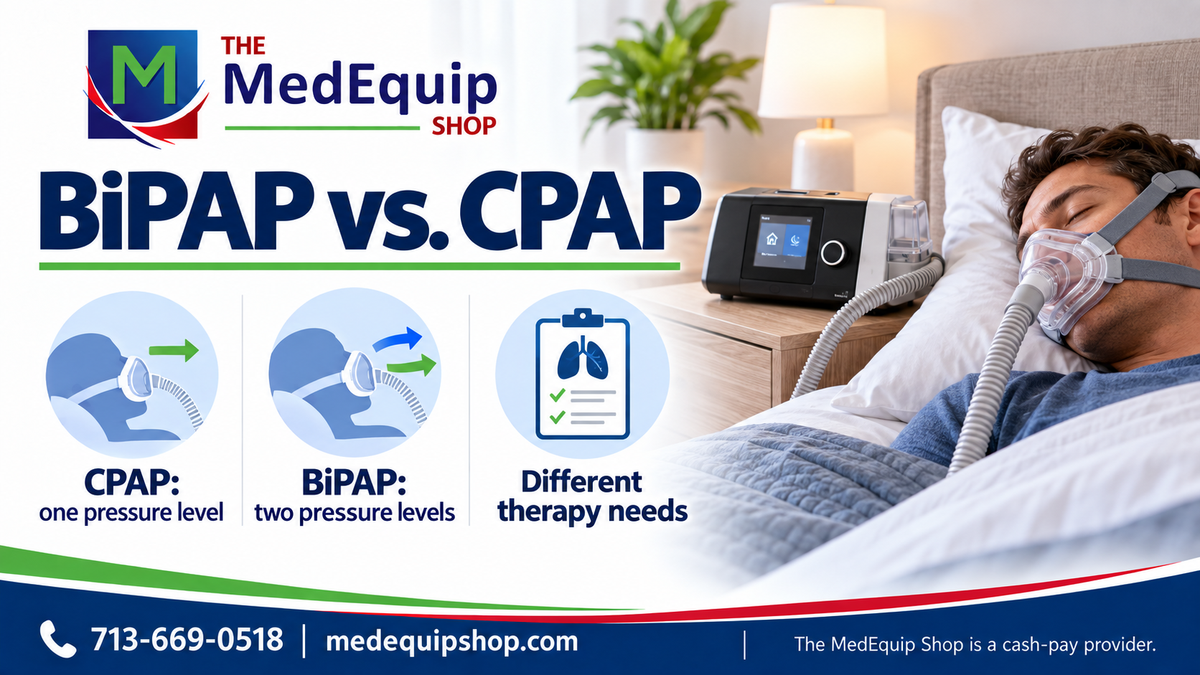
If you have any respiratory issues like COPD or any other, you may have discussed your treatment options with your healthcare provider. These may include the use of inhalers, stopping smoking, oxygen therapy, and other strategies. An additional treatment option is positive airway pressure (PAP) therapy, which employs specialized devices known as BiPAP and CPAP to improve your respiratory function.
If you are contemplating the use of either of these devices, you might be curious about the precise differences and which one suits your needs. In this post, we explore the advantages of each option and provide guidance on optimizing your treatment based on the choice you ultimately make.

Understanding CPAP Machines
Continuous Positive Airway Pressure (CPAP) is a widely used therapy for individuals having sleep-related breathing disorders, such as sleep apnea. The chief function of a CPAP machine is to deliver a constant and steady flow of air at a steady pressure. Here are the key features and aspects of CPAP:
Constant Pressure
Fixed CPAP delivers the treatment pressure prescribed to help keep the upper airway open during sleep. An operating range is not a personal pressure recommendation.
Single Pressure Setting
A CPAP machine functions at a single pressure setting, as prescribed by a healthcare professional, based on how severe the breathing disorder is.
Treatment for Sleep Apnea
CPAP is commonly prescribed for obstructive sleep apnea. Central sleep apnea needs specialist assessment; do not assume fixed CPAP is appropriate because a central apnea is described as mild.
Available comfort features vary by model and setup. Clinical pressure and therapy-mode changes should be directed by the treating clinician.
The advantage of a CPAP machine is that it helps in maintaining an open air passage and decreased breathing recesses that usually occur in sleep apnea, and hence improves the overnight levels of oxygen. It implies that you can experience an improved sleep quality, and you will wake up more refreshed and energetic.
Understanding BiPAP Machines
Compared to CPAP, BiPAP, short for Bi-level Positive Airway Pressure, is a more advanced therapy that provides two distinct pressure levels: one for breathing in (IPAP) and another for breathing out (EPAP). It is usually recommended for individuals who find it difficult to adjust to the constant pressure of CPAP. Here are the key features and aspects of BiPAP machines:
Dual Pressure Levels
BiPAP delivers higher pressure during inhalation (IPAP) and lower pressure during exhalation (EPAP), making it more comfortable and easier to breathe for users.
Adjustable Settings
BiPAP machines offer adjustable and fixed IPAP and EPAP settings, allowing healthcare professionals to customize the therapy to suit each individual's specific needs.
Treating Various Conditions
Bilevel therapy may be prescribed for selected conditions, but modes and capabilities differ. The clinician determines the appropriate device and settings.
Bilevel uses different inhalation and exhalation pressures. Compare the exact prescribed mode and support requirements; it is not universally better, harder to use or more suitable than CPAP.
BiPAP vs. CPAP
| BiPAP | CPAP | |
| Pressure | Dual pressure level | Single pressure setting |
| Settings | Adjustable settings | Constant setting |
| Treatment for condition | Selected conditions when the treating clinician prescribes an appropriate bilevel mode | Commonly used for obstructive sleep apnea when prescribed |
| Portability | Size and transport requirements vary by model | Size and transport requirements vary by model |
| Cost-effective | Request the complete quote for the prescribed model | Request the complete quote for the prescribed model |
| Ease of use | Training and controls vary by model | Training and controls vary by model |
BiPAP vs. CPAP- Choosing the Right Therapy
Choosing between CPAP and BiPAP depends on various factors, including your specific respiratory condition, comfort level, and response to therapy. Here are a few considerations in this regard:
Ideally, CPAP is considered a treatment option if:
- You have been diagnosed with obstructive sleep apnea (OSA).
- You can comfortably tolerate a constant pressure throughout the breathing cycle.
- Your healthcare professional recommends CPAP based on the severity of your sleep apnea.
On the other hand, BiPAP is recommended if:
- A specific bilevel mode is prescribed following the clinician’s assessment; a diagnosis alone does not determine the model.
- You find it challenging to adapt to the constant pressure of CPAP.
- Your healthcare professional suggests BiPAP based on your respiratory needs and overall health.
Final Thoughts
As we can see, both CPAP and BiPAP are instrumental respiratory therapy machines intended to improve breathing and enhance the quality of life for individuals with various respiratory conditions.
Understanding their differences and consulting with a healthcare professional will enable you to make an informed decision and select the therapy that best addresses your breathing requirements and circumstances. It is important to remember that the goal is to find the treatment that provides optimal support and helps you breathe easier, ensuring you lead a healthier and more soothing life.
Frequently asked questions
What is the pressure difference between CPAP and BiPAP?
CPAP uses one prescribed pressure in fixed-pressure mode. BiPAP uses separate inhalation and exhalation pressures, usually with a lower pressure when breathing out.
Is BiPAP automatically better than CPAP?
No. Each therapy serves different needs. The choice depends on the diagnosis, prescribed support, comfort, and clinical response rather than one device being universally better.
Can I switch from CPAP to BiPAP myself?
Consult your treating clinician before changing therapy. A different device or pressure mode may require a new prescription and a review of your treatment needs.
What should I compare when shopping for a prescribed device?
Compare the required therapy mode, comfort features, humidification, portability, compatible supplies, and cost. Check that the device matches your prescription.
Who can help me understand CPAP and BiPAP options?
Your clinician determines the treatment. MedEquip Shop can explain equipment features, compatible supplies, and purchase options for the prescribed device.